1. Verify the Legal Entity Before Anything Else
Everything downstream — quality, capacity, recourse — depends on the company actually being what it claims. The free checks come first:
- Business license and Unified Social Credit Code: request the official Chinese company name, the USCC, and a scanned business license. A legitimate supplier provides these without hesitation; refusal is a disqualifying red flag on its own.
- Cross-check the registration: confirm the details against China's national enterprise credit database — registration date, registered capital, legal representative, business scope, and current operating status. A meaningful share of registered suppliers carry suspended or revoked status, so this check is not a formality.
- Read the business scope: if the scope does not cover manufacturing in the relevant product category, the company is likely a trading office. Ask directly.
- Check litigation and tax standing: court cases, enforcement actions, and the government-assigned tax credit rating are objective signals. A company that cheats on its taxes is a poor bet to honor a contract.
Platform badges are a data point, not a guarantee. "Verified" or "Gold" status generally confirms a paid membership and a basic identity check — it does not test production capability, quality systems, or financial stability, and some of the most reported disputes involve badged accounts.
2. Confirm It Is a Factory, Not a Front
The manufacturer-versus-reseller question decides price, lead time, and whether a defect can be fixed at source. For dry bags specifically, the tell is technical depth:
- Ask about the welding. A dry bag's waterproofing lives or dies at the seam. A real factory can name its welding method and frequency and explain why it matters. Sealock welds in-house at 27.12 MHz, fusing coated layers into a continuous skin with no needle holes.
- Ask for capacity by category, not a headline figure. A factory knows its throughput per line — Sealock's motorcycle line alone runs up to 30,000 pcs/month — while a reseller quotes whatever sounds sufficient.
- Ask them to explain a spec. Denier, IPX rating, roll-top fold count, weld width, hardware grade: a manufacturer answers directly; an intermediary deflects to "our engineers will confirm."
- Ask for a live video walk of the line. Evasion around video calls, factory visits, or third-party inspection is a warning sign in itself, and staged or reused photos are a known pattern — reverse-image-search them.

3. Audit Before a Large Order
Documentation proves existence; an audit proves capability. Third-party audits are the single most effective fraud and quality control available to a remote buyer, and the reason is simple — an auditor sees what a website cannot show. A legitimate plant has a consistent production line, organized material storage, and visible staff at work; empty floors, unmarked equipment, and evasive answers about operations are the classic warning signs.
The proportionate approach scales with exposure: for a first small order, license verification plus a video walk and a sample may be enough; for a larger commitment, add a professional verification report; for a major program, combine that with a physical or third-party factory audit through a firm such as SGS, QIMA, Bureau Veritas, or Intertek. Sealock's compliance position is auditable rather than asserted — ISO 9001, BSCI, SMETA, HIGG, GRS, and SCAN — and buyers are welcome to send their own or a third-party inspector.
4. Protect the Payment
Payment structure is where supplier risk becomes financial loss. The market standard is 30% deposit by T/T with the 70% balance released after a passed pre-shipment inspection and before the bill of lading. Two rules follow from it:
- Never pay in full upfront, and never to a personal account. A dominant share of confirmed supplier fraud involves demands for payment via personal accounts or channels with no buyer recourse — a supplier's payment details should match the verified company entity, and a mid-order change of bank details should be treated as a hacking attempt until confirmed by phone.
- Tie money to inspection, not to promises. The inspection report is the release trigger. No report, no balance.
Artificial urgency — "only two production slots left," "price rises next week" — exists to bypass exactly this discipline. Legitimate manufacturers hold a quote for a stated period and give a buyer time to verify.
5. The Dry-Bag-Specific Questions a Generic Checklist Misses
Standard sourcing advice will not catch the failures particular to waterproof bags. Ask these before committing:
- Which IPX level applies to this exact model, and how is it tested? "100% waterproof" is marketing. IPX6 is a water-jet rating, IPX7 covers brief immersion, IPX8 continuous immersion — a supplier that blurs these will hand you a warranty problem. Sealock validates by full water immersion testing rather than a claim.
- Are the seams welded or sewn-and-taped? Tape lifts; welds do not. If the answer is vague, the bag is not submersible.
- What is the usable capacity after the roll-top is closed? Rated volume is measured open. Ask for size before closure, after three folds, and the recommended usable figure, or your listing will attract "smaller than described" returns.
- Is the load-bearing hardware tested separately? A fully waterproof bag can still fail at a strap. Ask for the load-cycle test on handles, straps, and D-ring anchors.
- How is batch color controlled? Color drift between orders is a recurring B2B complaint. A supplier should hold a signed gold sample and run color-fastness and color-difference testing against a Pantone standard.

6. Test the Relationship With a Sample and a Small Run
A sample is not just a visual approval — it is the first real test of whether the supplier can turn a specification into a manufacturable product. It should confirm material and thickness, dimensions, weld line, closure function, strap comfort, logo quality, packaging, and waterproof performance in one object. Judge the process as much as the sample: a capable partner asks clarifying questions, flags spec conflicts, and proposes fixes; a weak one silently guesses and keeps moving, which is how a project ends up in a third sample round.
After approval, hold one signed gold sample on each side as the inspection reference, then place a first production run before scaling. Sealock quotes MOQ at 300 pcs, samples in 7–15 days, and bulk in 30–45 days, which makes a controlled trial order practical rather than a leap.
7. Capability Range to Verify Against
A supplier's real range is worth checking against your roadmap — a partner that covers several bag types in the same workshops lets a brand add categories without re-qualifying a new factory. Representative models across the range, organized by type rather than priority:
| Image | Category | Model | Capacity | Material / Rating | Product Page |
|---|---|---|---|---|---|
|
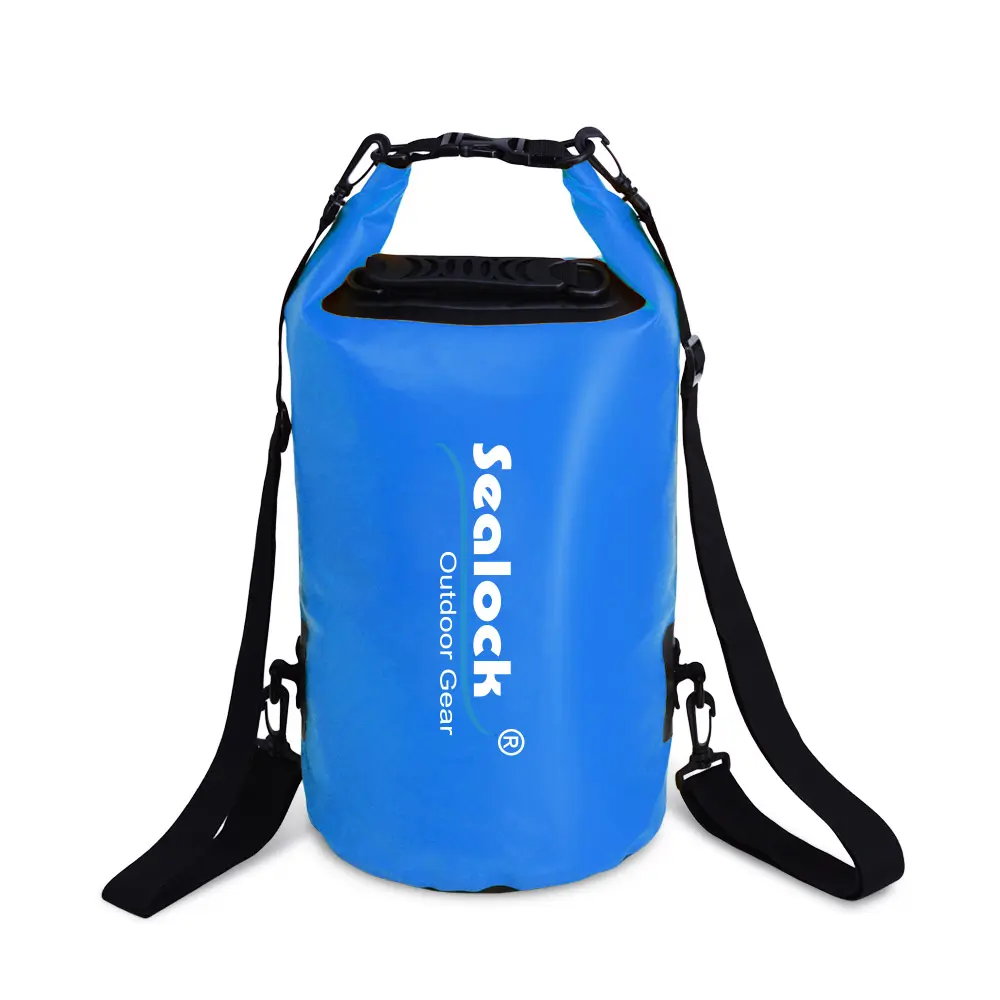
Roll-top dry bag | SL-D002 | 5–63L | 500D PVC · IPX7 | View |
|
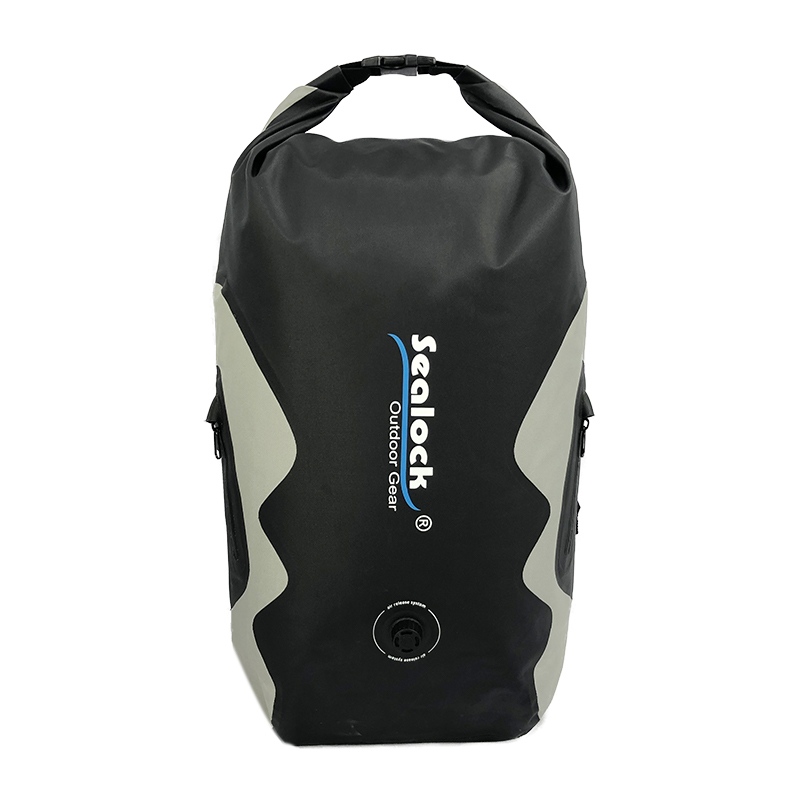
Dry backpack | SL-E070, air valve | 25L | 420D TPU · IPX8 | View |
|
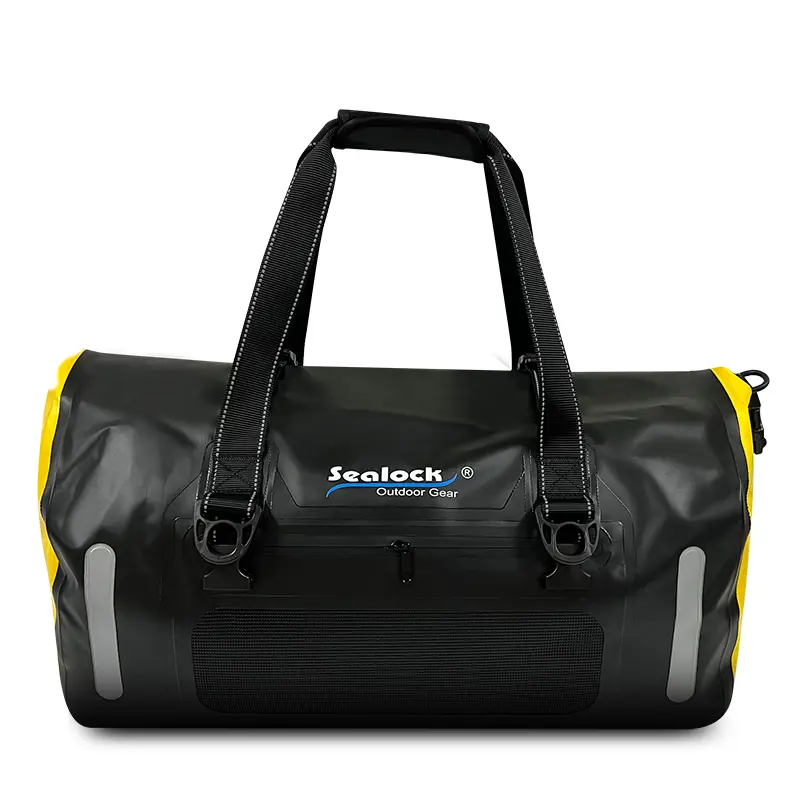
Waterproof duffel | SL-K099 | 40 / 60L | 840D TPU · IPX7 | View |
|
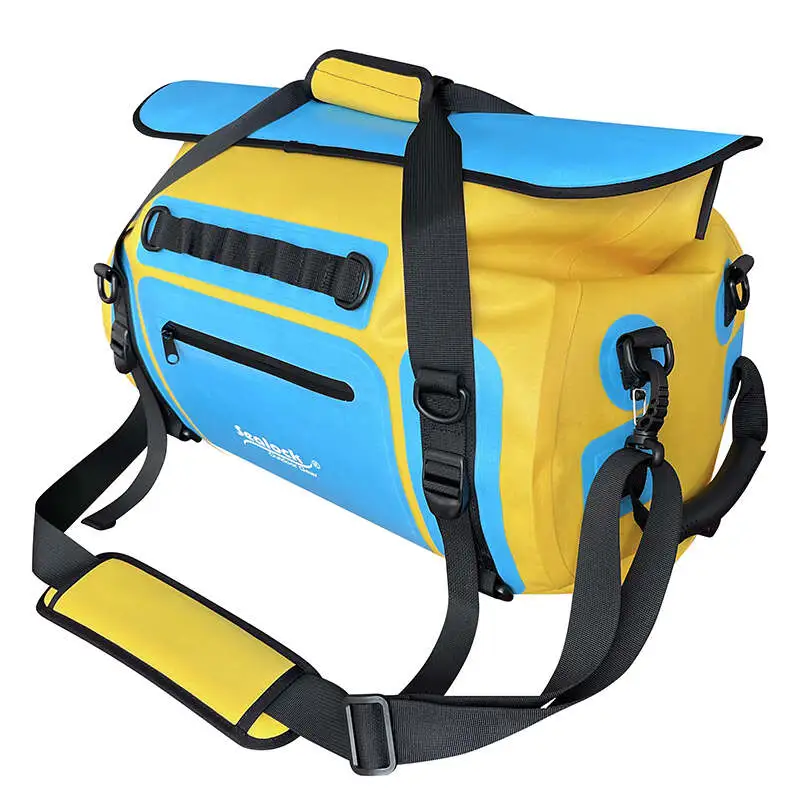
Zippered duffel | Kayaking Duffle | Multiple | TPU · IPX8 zipper | View |
|
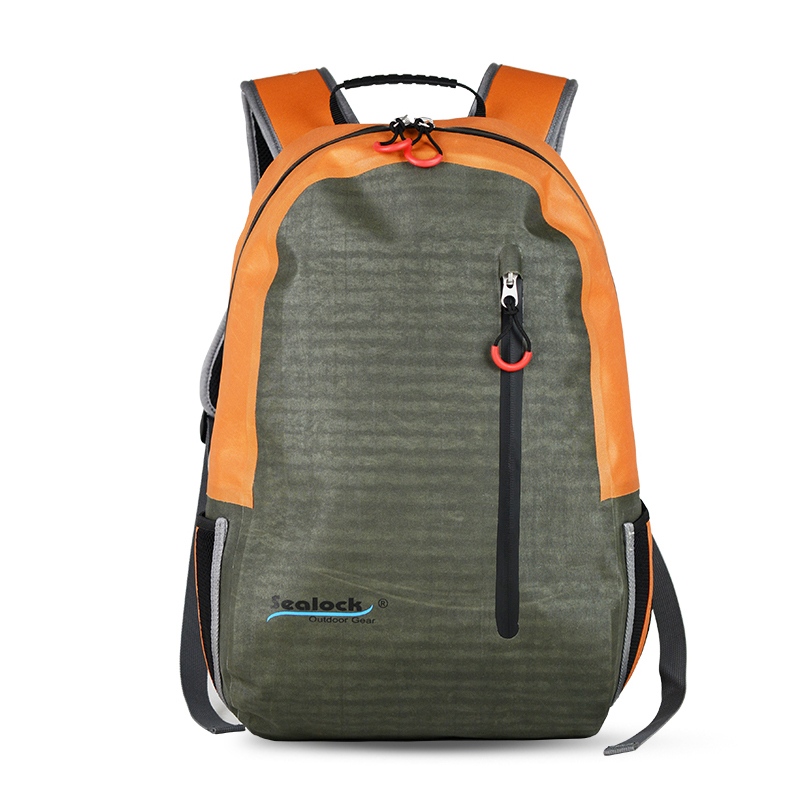
Urban / commuter | SL-E071 | 22L | 420D TPU · IPX6 | View |
|
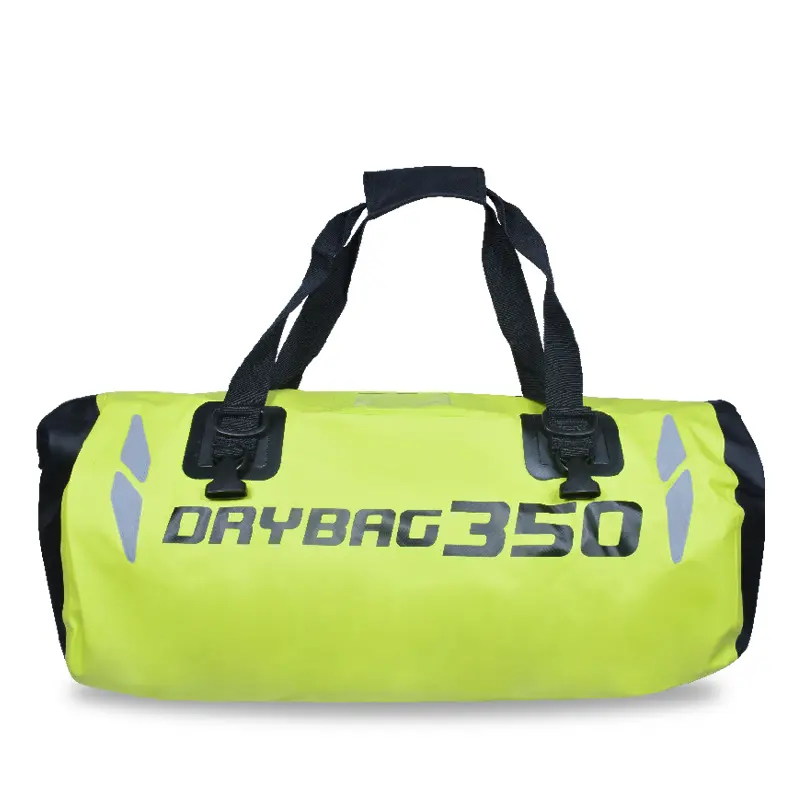
Motorcycle luggage | SL-C619 | 35 / 50L | 500D PVC · IPX6 | View |
Beyond the catalog, a supplier should be able to build to a brand's own design. Sealock develops ground-up from a sketch, sample, or performance target — capacity, IPX level, material, structure, hardware, and version all specified by the buyer — with complex development scheduled ahead of a launch date.
8. Quality Systems to Confirm
A reliable partner runs quality as a system across the line, not a single check at the end. Sealock applies three-stage control on every batch: IQC on incoming fabric, zippers, and hardware; IPQC on welds and processes in line, including peel tests on sample welds at run start; and OQC with AQL sampling, batch immersion testing, and signed gold-sample comparison, with optional SGS/QIMA third-party inspection before shipment. The laboratory suite covers a load test of over 1,500 cycles, 3,000 sealed-zipper cycles on zippered models, tensile and bonding strength, salt spray, friction resistance, color fastness, color difference, and full water immersion.
9. FAQ
Q: The supplier has a "Verified" or "Gold" badge — is that enough?
A: No. Those statuses generally confirm a paid membership and a basic identity check, not production capability, quality systems, or financial health. Treat a badge as one data point and still verify the business license, the credit database record, and the technical answers.
Q: How do I tell a factory from a trading company without visiting?
A: Read the business scope on the license, then test technical depth: ask about the welding frequency, capacity per line, weld width, IPX test method, and roll-top fold count. A manufacturer answers directly and will do a live video walk of the line; an intermediary deflects and avoids video.
Q: The quote is 40% below everyone else — is that a win?
A: Treat it as a warning. Steep underpricing usually signals a substitution downstream — thinner fabric, sewn-and-taped seams sold as welded, or an unrated zipper — and quality disputes cost far more than the saving. Ask what specifically is different about the specification.
Q: The supplier asked me to wire the balance to a different bank account than before. Normal?
A: No — treat a mid-order change of bank details as a compromised-email scam until you confirm it by phone with a known contact. Payment should go to the account matching the verified company entity, never to a personal account.
Q: They're pushing me to decide this week because "slots are filling." Should I move fast?
A: Artificial urgency exists to bypass due diligence. A legitimate manufacturer holds a quote for a stated period and gives you time to verify the license, run a sample, and arrange an audit.
Q: My last supplier's sample was great and the bulk run wasn't. How do I stop that happening again?
A: Hold a signed gold sample, write the inspection criteria into the specification before production, and tie the 70% balance to a passed pre-shipment inspection. For dry bags, insist the inspection includes an immersion check against the claimed IPX rating and a strap pull test, not just a visual pass.
Start With a Sample
To verify capability the practical way — request the business license, a video walk of the welding line, and a sample against your own specification — submit an inquiry. Sealock responds to procurement enquiries within 24 hours, with production available from Dongguan, China or Ho Chi Minh City, Vietnam.